Working with Organic Jet
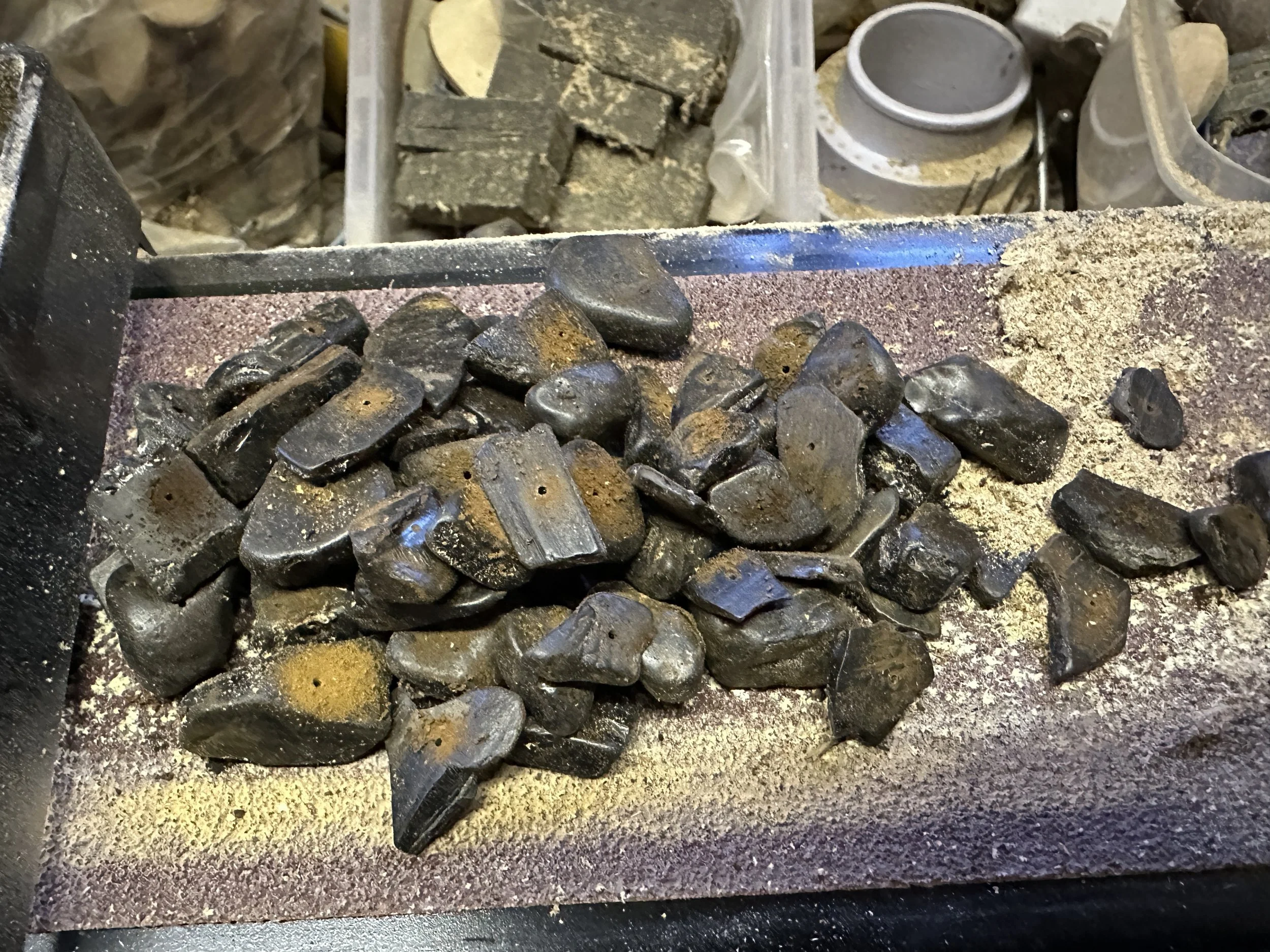
Image shows small pieces of whitby jet drilled on top of a sander, the dust from the drilling is left on the pieces to show that the colour of the dust is light brown not black.
Today I've been in the workshop carefully drilling some of my stash of Whitby Jet. While I use Lignite jet beads along with Baltic Amber to create some of my witches necklaces (bought from trusted suppliers, and randomly tested). Drilling jet is a messy business - the dust gets everywhere, and it doesn’t smell as good as drilling amber.
Amber and Jet beads, strung together are traditionally worn by Wiccans (of which I am not). Different covens might have different ratios or numbers of beads, and restrictions on who in a coven can wear an amber and jet necklace - which is knowledge I don’t have to pass on.
Amber, traditionally is associated with the Sun, while Jet is associated with the moon - both are ancient plant materials - amber is fossilised tree sap, jet is jetionised wood…. both have mythological properties (which maybe I’ll write about another day). Despite not being stones, both are considered to be gemstones.
Apart from adoring the combination and feel of both amber and jet, they are also - generally - ethically obtained, unlike many gemstones out there.
Once upon a time I worked for a retired geologist in a wee rock and gem shop in a university town - he taught me some of the tips and tricks to identify jet from all the imitations out there.
There's a whole lot of facts, fiction and myths around Jet, and especially Whitby jet (said to be the finest jet in the world)... including one of the ones (and which was my favourite) I was taught a long while back: that jet is only made from fossilised monkey puzzle tree (it's not... check the link below from Ebor jet works in Whitby who specialise in Jet research and make some amazing things as well.
Identifying jet can be challenging when there's so much fake stuff on the market, and when AI tells you things are facts when really they’re not!
Real, organic Jet is light in weight, it's black and it's warm to the touch. It can be polished, and it’s hard - it won’t flake or leave your hand dirty, and it won’t smell, other than perhaps a little of the sea.
High quality jet might float in water (or at least sink slowly), polished jet can sometimes be persuaded to hold a static charge - enough to attract dust to it if you polish it with a piece of silk (and this is a challenge when polishing the stuff, since it wants to hold onto it's own dust)…. but not all jet will float, especially if it has pieces of rock layers in it, and getting it to hold a static charge can be challenging.
The most reliable test is what's called the streak test - black jet will make a brown streak on a piece of something slightly rough (i use fine sand paper) - or create a pile of brown dust and a smell similar to burning coal when drilled..... thus the photo below showing the brown dust created - the paler the dust, the better quality the jet.
Plastic will create a white mark (usually), glass and onyx won't really mark at all, and coal will create a black mark if you test it. From experience, coal will often shatter when you try and drill it.
So the good news - for me (and my customers) - that these pieces are real…. and ready to be strung with amber into a gorgeous creation.
You can find some of my creations here ready for you to buy
and to learn more about Jet, check out the Ebor Jet works page who have a lot of fascinating information to learn more about jet from.